
 Image 1 of 3
 Image 2 of 3
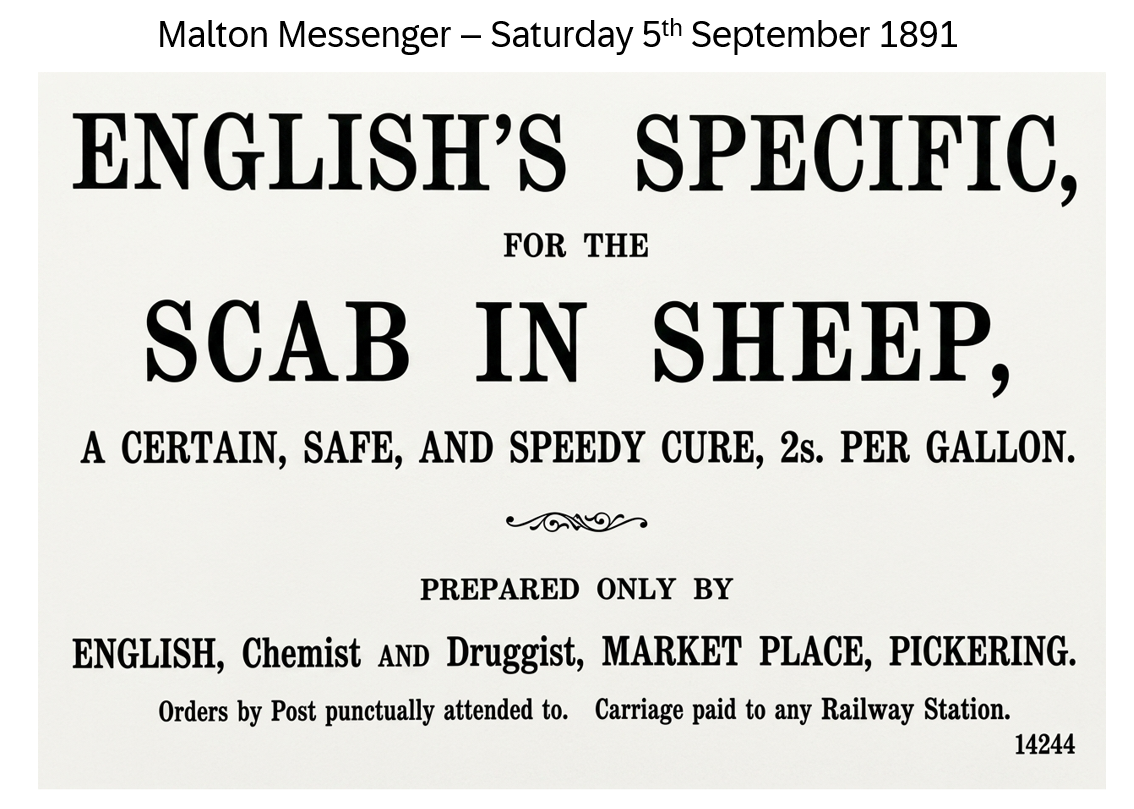 Image 3 of 3
This text replicates a newspaper advertisement from the Malton Messenger, published on Saturday 5th September 1891. It spotlights the critical intersection of Victorian chemistry, local commerce, and the agricultural backbone of North Yorkshire. The business owner, Mr. English, operated as a professional "Chemist and Druggist" in Market Place in Pickering. During the late-Victorian era, a rural town chemist was a vital community pillar. They did not just dispense human medicine; they acted as impromptu veterinarians, compounding specific chemical treatments to safeguard the livelihoods of the surrounding farming community.
The advertisement promotes "English’s Specific for the Scab in Sheep," a commercial remedy targeting sheep scab. This highly contagious, debilitating skin disease is caused by parasitic mites (Psoroptes ovis). In the 19th century, an outbreak of sheep scab could utterly devastate a North Yorkshire farm, ruining the wool quality and decimating the livestock. English’s formulation was pitched as a "certain, safe, and speedy cure" at the accessible price of 2 shillings per gallon.
The mention of "Carriage paid to any Railway Station" captures the booming industrial environment of 1891. By leveraging the region's expanding railway network, this small-town Pickering chemist could effortlessly fulfill mail orders, transforming a local remedy into a widely distributed regional product.
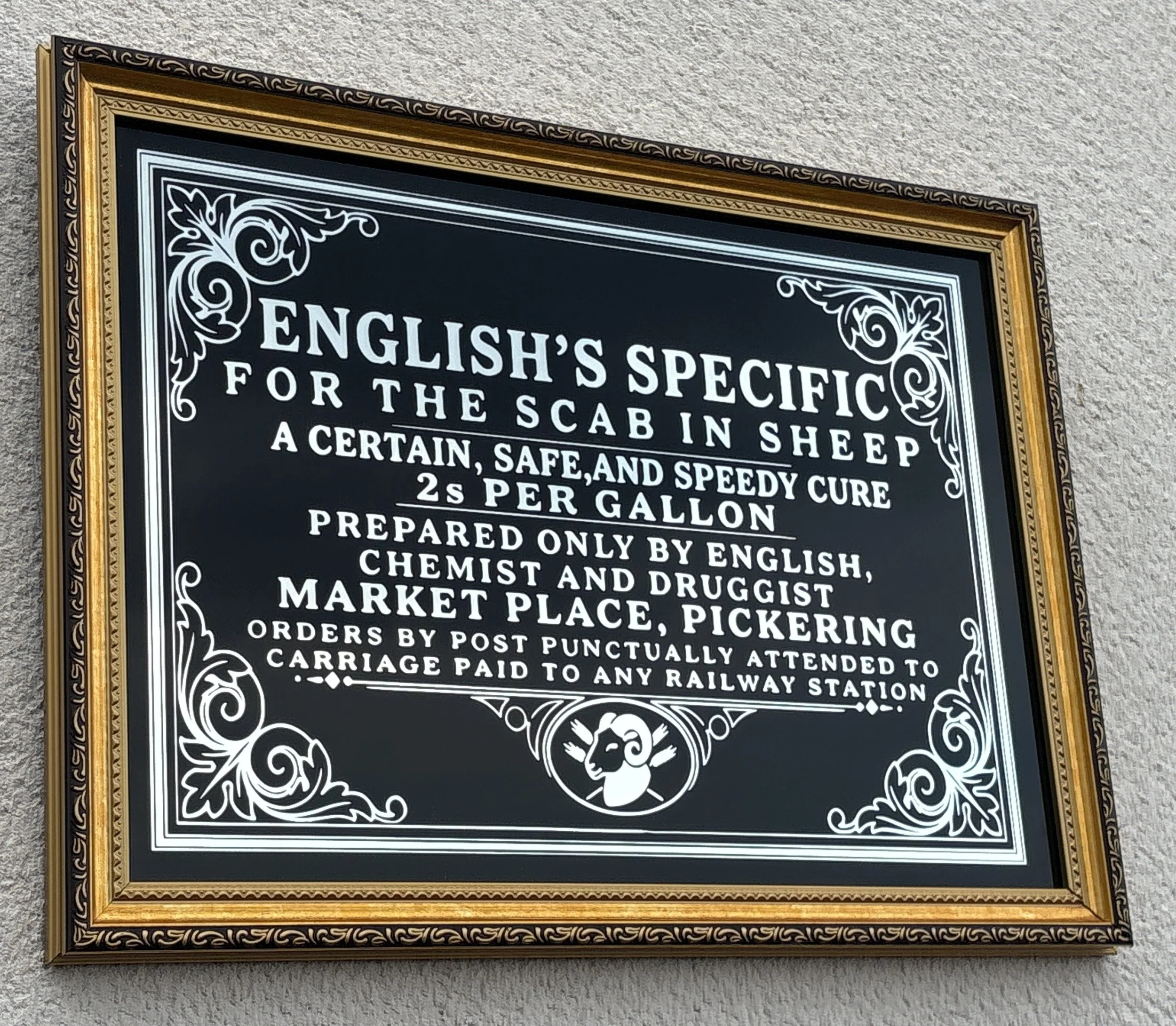
Here we’ve taken the wording from an advertisement in the Malton Messenger of 1891 and created a reverse glass mirrored sign designed with fonts and decoration appropriate to the period.
This text replicates a newspaper advertisement from the Malton Messenger, published on Saturday 5th September 1891. It spotlights the critical intersection of Victorian chemistry, local commerce, and the agricultural backbone of North Yorkshire. The business owner, Mr. English, operated as a professional "Chemist and Druggist" in Market Place in Pickering. During the late-Victorian era, a rural town chemist was a vital community pillar. They did not just dispense human medicine; they acted as impromptu veterinarians, compounding specific chemical treatments to safeguard the livelihoods of the surrounding farming community.
The advertisement promotes "English’s Specific for the Scab in Sheep," a commercial remedy targeting sheep scab. This highly contagious, debilitating skin disease is caused by parasitic mites (Psoroptes ovis). In the 19th century, an outbreak of sheep scab could utterly devastate a North Yorkshire farm, ruining the wool quality and decimating the livestock. English’s formulation was pitched as a "certain, safe, and speedy cure" at the accessible price of 2 shillings per gallon.
The mention of "Carriage paid to any Railway Station" captures the booming industrial environment of 1891. By leveraging the region's expanding railway network, this small-town Pickering chemist could effortlessly fulfill mail orders, transforming a local remedy into a widely distributed regional product.
Here we’ve taken the wording from an advertisement in the Malton Messenger of 1891 and created a reverse glass mirrored sign designed with fonts and decoration appropriate to the period.